
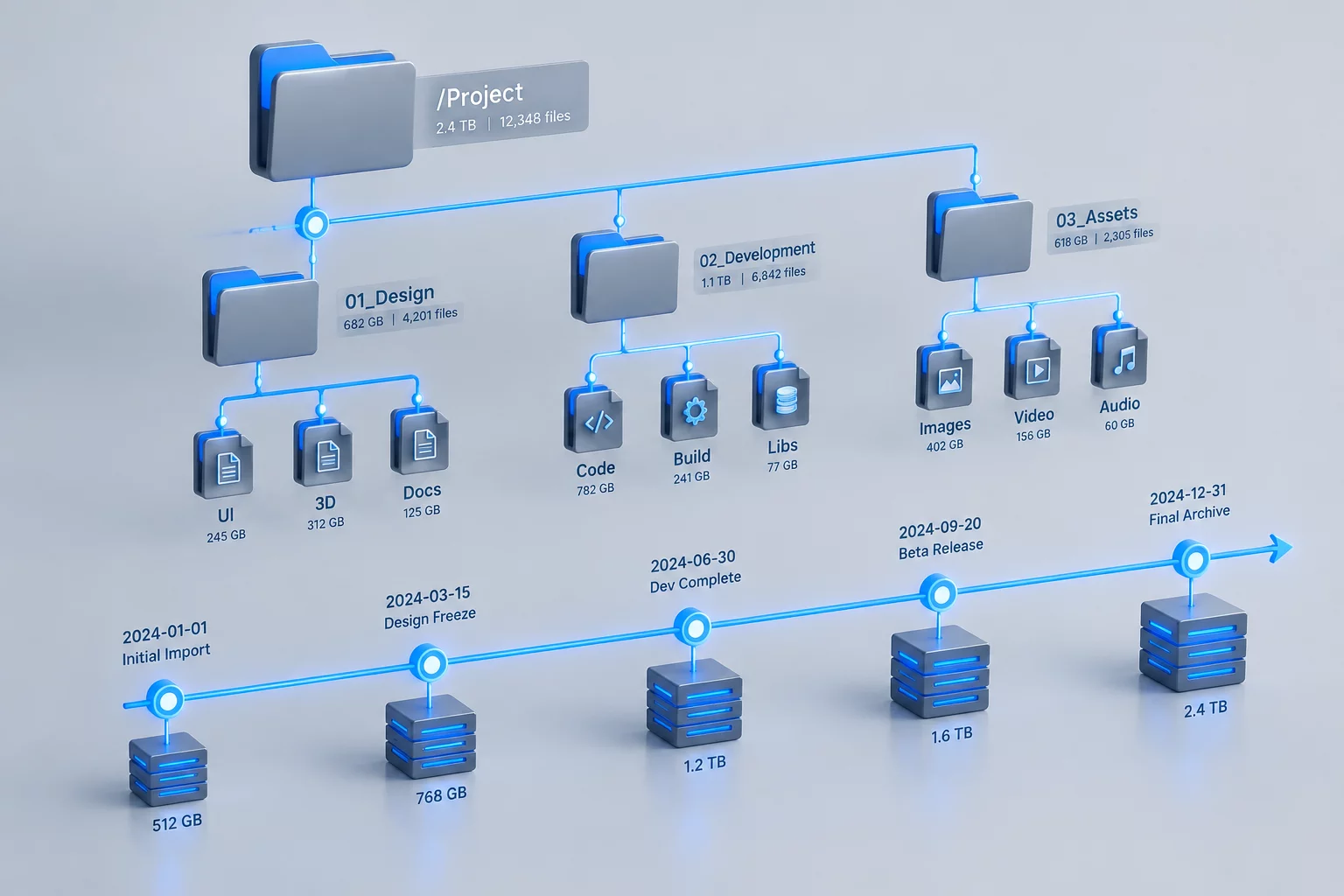
How 284 GB Ballooned to 426 GB Without Apparent Scope Changes
When the production team closed Draft Revision 3 for executive sign-off, the main working directory recorded an exact footprint of 284.4 GB. Three weeks later, the archiving script flagged that the same project folder had crossed 426.4 GB during pre-handoff packaging. Nobody had added new camera raw footage, and the approved sequence length had changed by less than twelve seconds.
Workstation operators assumed the jump came from final packaging compression variations, yet standard delivery containers could not account for 142 GB of additional disk pressure. By capturing metadata manifests through WizTree before and after the handoff pipeline executed, we began tracing every newly allocated byte down to individual nested directories.
Our storage engineering team parses point-in-time filesystem tables to reveal rogue caches, unlinked staging copies, and runaway compilation outputs.
Tracing Rogue Cache Branches and Uncleaned Transcode Trees
Comparing the CSV exports of both volume states through our differential engine exposed multiple clusters of unindexed files. Instead of an even growth spread across all assets, disk usage had concentrated inside three overlooked subdirectories hidden beneath nested pipeline configurations.
- The compositor had written uncompressed intermediate TIFF sequences directly into a local scratch subfolder instead of the designated centralized cache volume.
- Automated delivery validation scripts duplicated the master deliverables into an unmonitored staging folder while packaging redundant uncompressed backups.
- Audio mastering utilities generated iterative multi-track session revisions that preserved every discarded uncompressed track alongside the deliverable stems.
None of these files were visible in the primary file manager project view because operators only navigated through software-specific open dialogs. The files sat idle, consuming high-speed SSD tier capacity without contributing to the delivered master package.
Between a client-approved draft and the final export, projects rarely accumulate legitimate creative data. What multiplies is operational exhaust: caches, duplicate exports, and forgotten test renders that silently consume tier-one storage.
The Numbers Behind the 142 GB Discrepancy
We indexed both snapshots with full path hashing to isolate added, modified, and deleted items. The audit revealed that genuine delivery files represented only 18.2 GB of legitimate growth, while the remaining 123.8 GB consisted exclusively of temporary artifacts generated during final assembly.
Because the staging clones duplicated high-bitrate containers that were already stored on client-facing SFTP distributions, their existence on internal NVMe pools created unnecessary expense and delayed cold archive ingestion by four days.
Automating Pre-Archive Snapshot Verification
To eliminate post-draft storage bloat permanently, our engineering team introduced an automated pre-archive differential gate. The gate generates a fast WizTree inventory upon status change to 'Approved Draft' and compares it with the final state upon transition to 'Delivered'. Any non-whitelisted path expanding by more than 5 GB triggers an automated alert, preventing pipeline closure until unwanted render scratch branches are purged.