
The Disappearing Volume and Normal Daily Workflows
Daily engineering operations rely on standard directory trees where teams interact with recognizable project folders, asset libraries, and master exports. In this production cluster, monitoring agents raised repeated high-capacity threshold warnings across a 2 TB primary storage volume. Yet the engineers reviewing user directories reported normal asset sizes and negligible week-over-week asset additions.
Interactive operating system browsers regularly hide dot-prefixed folders, sub-repository working caches, and deep-level application artifacts. When staff verified folder properties through conventional desktop interfaces, the calculated visible payload reached barely 680 GB. That left over 140 GB of disk consumption completely unaccounted for, producing a creeping capacity drain that threatened scheduled overnight rendering jobs.
Run automated snapshot diffing to identify silent directory expansions across nested production trees.
Comparing Sequential States Beyond Visual File Browsing
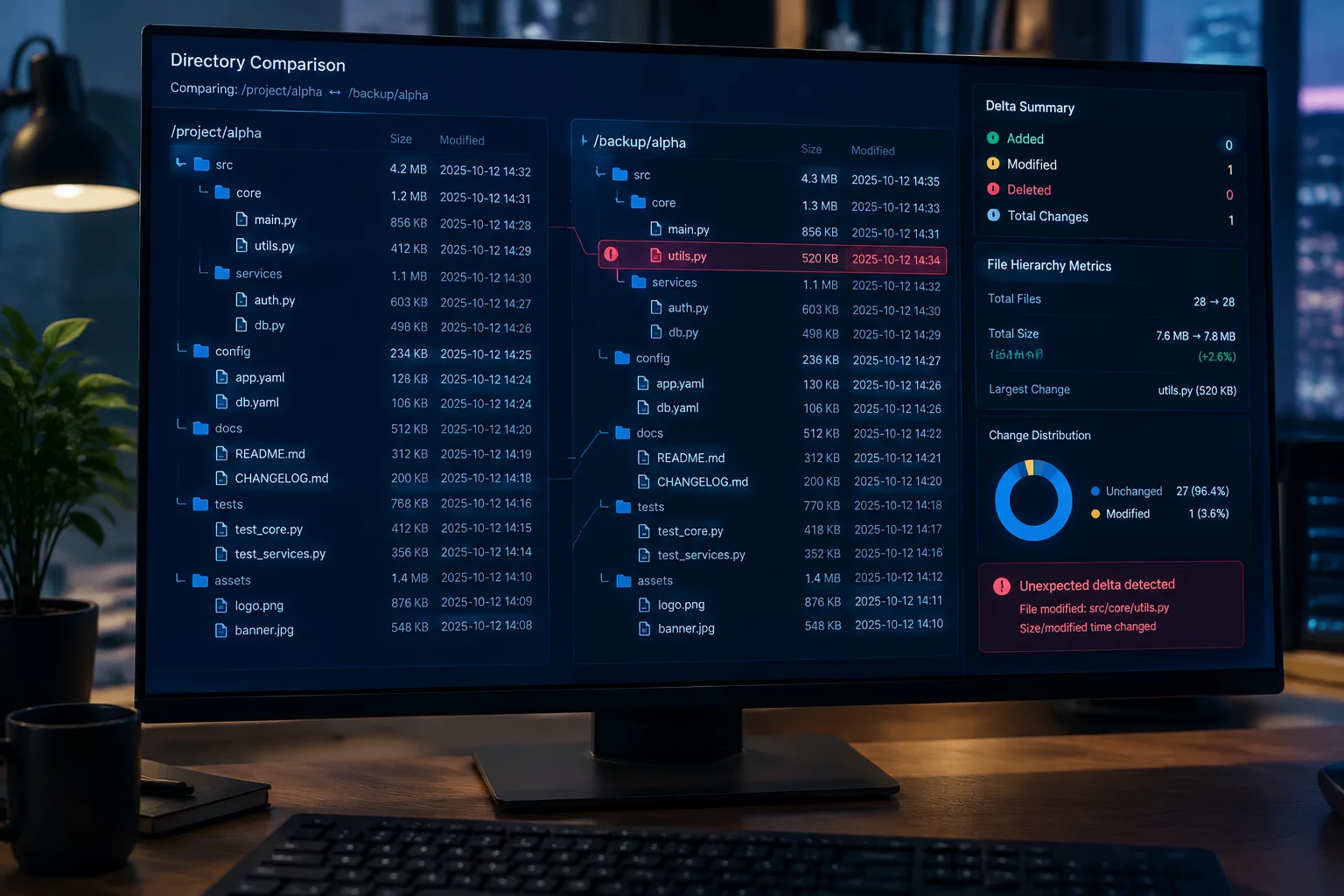
Rather than relying on manual directory inspection, our team exported two discrete file-system state snapshots. The primary baseline dated back to post-maintenance checks four weeks earlier, while the second capture recorded disk architecture immediately after the most recent threshold alert. Running a binary differential scan between these two snapshots surfaced every altered path regardless of folder visibility attributes.
- Baseline snapshot index captured immediately after quarterly infrastructure maintenance on September 12.
- Second state snapshot recorded 28 days later following intermittent low disk space alarms.
- Binary tree comparison isolated an undocumented hidden branch accounting for 142.8 GB.
The comparative index proved decisive. Instead of widespread growth across multiple client projects, ninety-nine percent of the total volume delta resided within a single nested path named `.render-cache/staging/blobs`. Because the path utilized Unix-style hidden prefixing and was situated outside user-facing bookmarks, no team member ever encountered it during routine daily workflows.
When daily file navigation relies on familiar root paths, automated background tools can quietly allocate hundreds of gigabytes without a single operator noticing until the host drive locks.
Autopsy of the Shadow Cache Structure
A deeper analysis of the newly isolated branch disclosed over nineteen thousand uncompressed image chunk files. An automated compositing service deployed five weeks earlier contained a default configuration directive that retained intermediate rendering stages indefinitely. Whenever a pipeline job executed, it wrote temporary binary blobs into this directory without triggering standard trash can or retention policies.
Because the software daemon generated files with standard user permissions, system antivirus and root analyzers ignored the files as ordinary user data. Without the snapshot comparison comparing the exact state before and after the daemon update, technicians would have continued scrutinizing visible project exports without identifying the actual leak origin.
Purge Procedures and Routine Differential Baselines
Resolution required a two-phase protocol. First, engineers safely drained the staging blobs directory after verifying zero active rendering threads held locks on the contained files. Second, the pipeline configuration script was modified to enforce ephemeral RAM disk usage for intermediate chunks alongside an aggressive three-day garbage collection cycle. Snapshot differential scripts now run automatically every Sunday evening, comparing weekly states and flagging any newly formed branch exceeding five gigabytes.